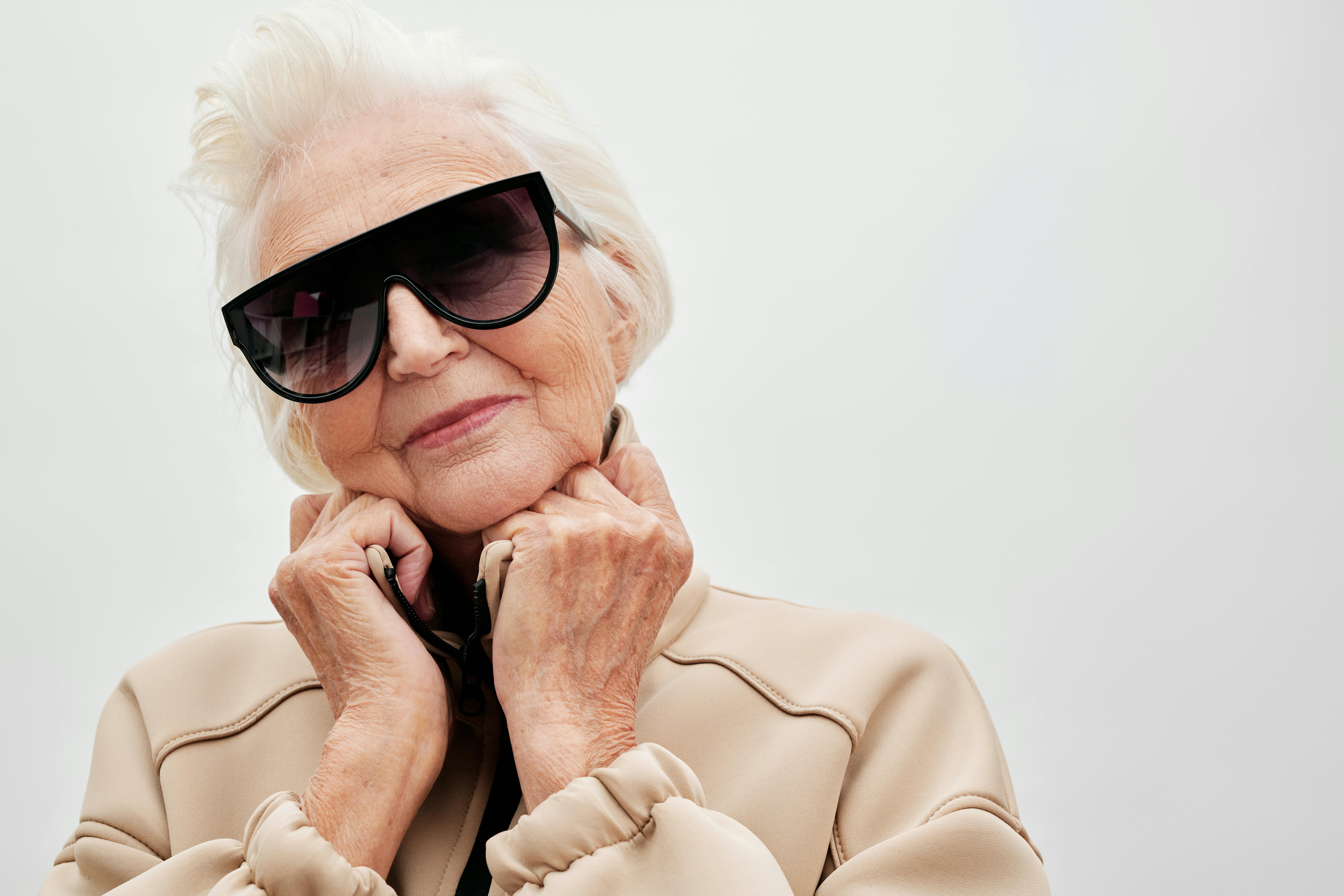
OLDER PEOPLE AS STYLE ICONS

It’s never been cooler to be in your 80s. From Aime Leon Dore to LOEWE, fashion is embracing age.

Iris Apfel showed the world a different way to be a centenarian. 

Immaculately dressed in maximalist couture, arms full of colourful bangles, with the warm playful energy of your favourite grandparent, the interior designer and New York socialite was a self proclaimed “geriatric starlet”, a fixture of Fashion Week front rows and celebrity magazine spreads until her passing in 2024, aged 102. 

Apfel was in good company. Over the past decade, luxury fashion houses have slowly shed the industry’s obsession with youth through notable celebrity campaigns that embrace experience, wisdom and age.

The first to go big was Celine’s 2015 campaign with cult New York writer Joan Didion, then 80, whose portrait in dark sunglasses became the most talked about shot in the world that season. Since then we’ve seen Dame Maggie Smith, 88 and Sir Anthony Hopkins, 84 for LOEWE, while Vanessa Redgrave, 86 joined Skepta, Raheem Sterling and Lennon Gallagher to launch Daniel Lee’s new vision for Burberry in 2023. From Aime Leon Dore to Dior, no lookbook today is complete without its own geriatric starlet. 

What’s behind this change in attitude from brands towards age? One explanation is the generational wealth shift. In the US and UK, Gen X and Boomers have more spending power and less consumption guilt than Gen Z, making them a sizable force for marketers to target. From this standpoint, luxury brands using older models and celebrating life experience is a logical business move that speaks to the people who can actually afford to buy designer clothing. That this also looks like a stand against ageism and unrealistic beauty standards, and is different enough to cut through the noise online, is but a happy coincidence. 

Luxury fashion advertising isn’t the whole story, though. Older style icons are building huge audiences on social media too. Larry Pennington, a 79-year-old Delaware native with a love of antique furniture, was profiled in the New York Times earlier this year after gaining a quarter of a million TikTok followers in a month. Even that number pales in comparison to the likes of glam-nan Helen Van Winkle aka Baddiewinkle (“stealing your man since 1928”) with 3m followers, or septuagenarian streetwear don ‘Gramps’ and his combined audience of 8m. 

What does this tell us about culture?

Only a decade ago the much publicised generation gap became the opening act in an era typified by political divides. Older voters swayed Donald Trump’s 2016 victory, and Britain’s decision to leave the EU in the same year was also dramatically influenced by age. Younger voters harbored intense resentment at their grandparents’ generation for compromising their future. ‘OK Boomer’ became the dismissive retort to almost any opinion expressed by somebody over 50. 

So how did older people become aspirational in the decade that followed? Wouldn’t we expect the opposite scenario to play out? We think the answer isn’t necessarily about age, but culture. 

We naturally feel warmth towards those who share our interests and outlook. When young people see the likes of Iris Apfel living their best lives, sharing the same passions and cultural spaces as them, it challenges the negative stereotypes about older people that permeated online after those divisive elections. And it resonates because we don’t want to be divided from one another. It feels good to go beyond assumptions and find common ground with supposed adversaries. Perhaps it even makes us feel more hopeful about our own futures, especially for those without family role models of that generation. In this respect, shared culture offers a space for understanding and bridge building.

Thought starters for brands

Culture beats demographics. Our passions and cultural interests say more about us than our date of birth – this is important to remember when thinking about how to reach audiences. You might have a fancy (and expensive) segmentation, but how can you upend that with cultural insights and data? Not to toot our own horn here, but we can help…


Iris said it best: “The fashion industry doesn’t just forget older people, it forgets middle aged people”. The same could be said for many other sectors, where obsession with fast moving tech and novel platforms can see experienced team members unwisely discarded. How could you get the most out of the experience within your own organisation?

To unlock more insights, email discover@culturelab.co 

(Sources: CultureLab CultureIndex, April 2025)