BLAZING PADELS

Just as you were getting your head around pickleball, there’s a new racket sport coming to your town. Padel is intense, addictive and presents a broadening of the traditional sports landscape for brands.

“Besides football, padel is the best game I’ve ever played.” – Jurgen Klopp.

Padel, pronounced ‘paddle’ or ‘pa-DELL’ depending on where in the world you’re playing, is the fastest growing racket sport on earth. Invented in 1969 by a group of friends in a garden in Acapulco, Mexico, padel is now played by 25 million people worldwide. David Beckham, Lioniel Messi and Andy Murray are all recent padel converts. Zinedine Zidane has a court in his garden. 

So what is padel?

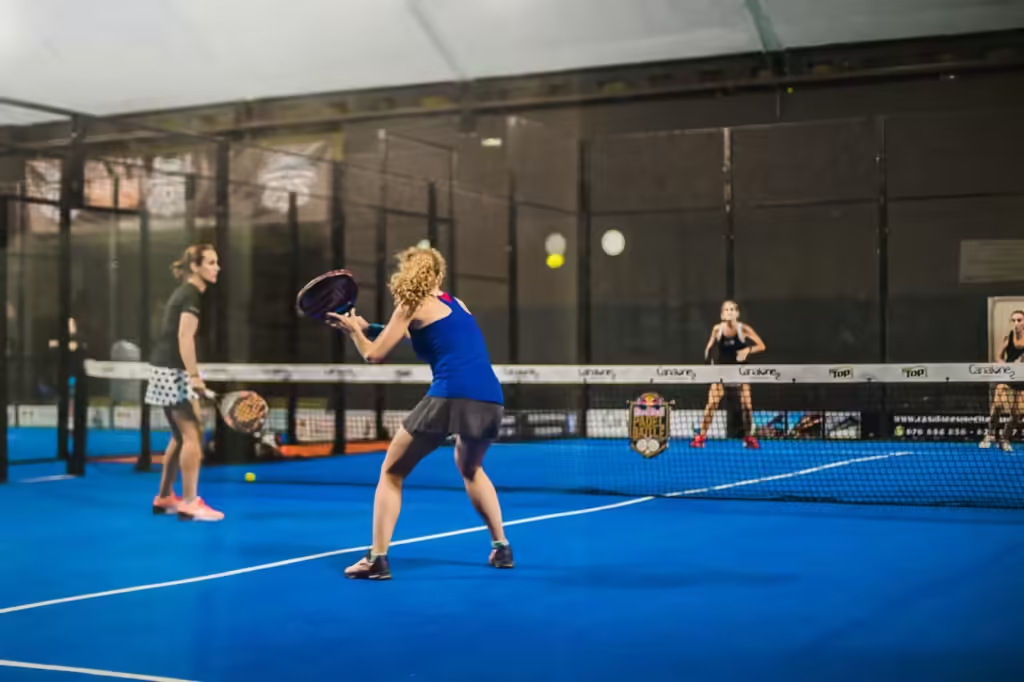
Sitting somewhere in the region of mini-tennis or giant ping-pong, players use a small paddle to hit a ball back and forth over a net until somebody misses. But unlike its pickled cousin, padel is played on an enclosed court, usually a glass box or metal cage, and players can hit off the walls, upping the pace and intensity and making for longer rallies. 

Low barriers to entry are key to the padel appeal. While athletically demanding, the level of skill and conditioning required to enjoy a fun, competitive game is lower than in tennis, for example. No expensive lessons in exclusive clubs are required. It has a grassroots, social feel (matches are almost always played in doubles) and makes for an easy after-work get together. 

While padel (and pickleball, for that matter) might never scale to the heights of global popularity that football and basketball have, it still represents an emergent culture that we can learn from. The diversification of sports more broadly is a fascinating development that’s bringing more people into sports. What makes these emergent sports most exciting for brands is when we begin to see their footprint beyond just a sport; padel has a unique style, a social aspect that steps into food and drink, and a multigenerational aspect that gives it a much broader ‘lifestyle’ appeal. This widens the aperture for brand involvement significantly. Here are our three key recommendations: 

  • Understanding that the growing popularity of padel, and indeed pickleball, speaks to an upending of traditional sports categories. From combat to racket sports, new activities are emerging from the niches to challenge the dominant forces, offering lower barriers to entry and injecting fresh energy into categories that may otherwise appear stale.
  • Even at a grassroots, casual, and ‘emergent’ level, brands can demonstrate their credibility within a subculture by applying a ‘mainstream mindset’. Don’t just think sports and sponsorship, but instead look at how these sports influence different areas of culture too; food and drink, fashion and beauty, health and wellness. By exploring these areas, your brand can demonstrate understanding and create a new connection to an emergent subculture. 
  • Most of the brands championing emerging activities like padel are from within the more traditional sports category. There is ample opportunity for brands outside this world to platform the communities themselves, tapping into the intensity, passion and social bonds, without the baggage or cost of traditional sports. Your brand can show the world that padel has meaning beyond the match itself. 

To unlock more sports insights, email discover@culturelab.co 

(Sources: CultureLab CultureIndex, July 2024)